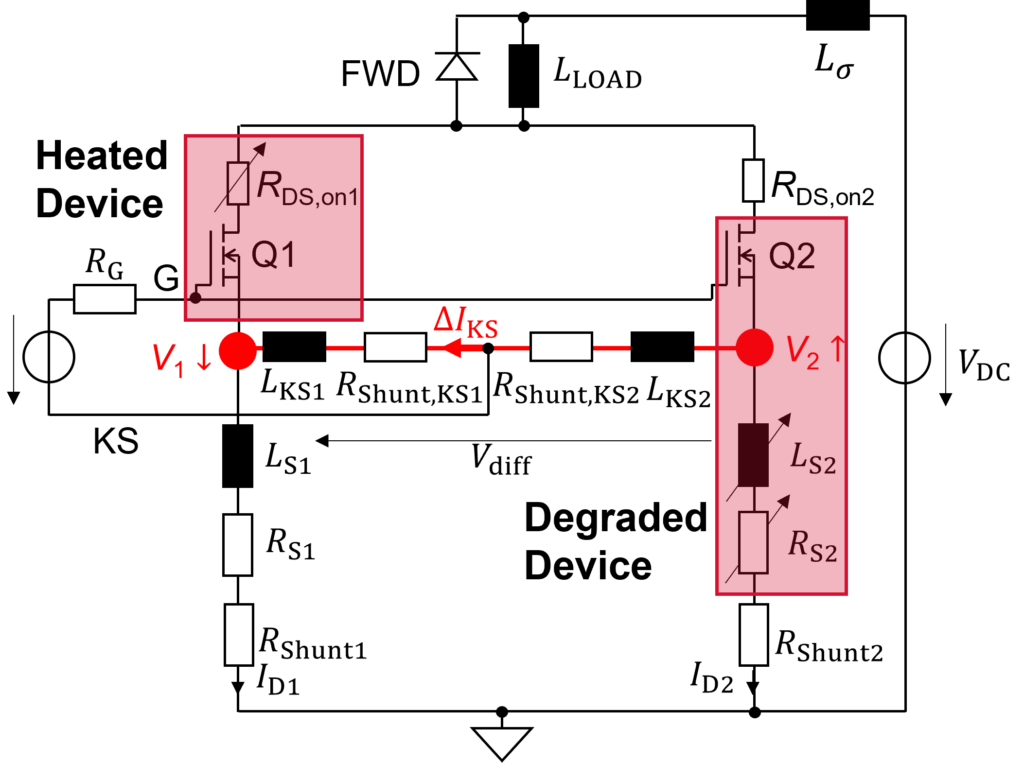
Bond wire lift-off and rising junction temperature both disturb the current sharing of parallel-connected SiC-MOSFETs — and in steady state, they can look surprisingly alike. Telling them apart matters: mistaking a harmless temperature swing for degradation (or the other way round) undermines any real-time health monitoring scheme built on the Kelvin-source current.
A new study by researchers from the University of Bremen and Kyushu University, to be presented at ICSCRM 2026 in Yokohama, investigates exactly this ambiguity — and shows how to resolve it.
Parallel SiC-MOSFETs are the standard way to scale up the current-carrying capability of a power module. But unavoidable mismatches between chips, together with layout-driven differences in parasitic inductance, mean the current is rarely shared perfectly. The Kelvin-source (KS) current — the small balancing current that flows through the shared source connection of two paralleled devices — has already been shown to reveal such asymmetries, including the very first stages of bond wire lift-off, well before they show up in the load current. The open question this work addresses is how a second disturbance, junction temperature, interacts with that same signal.
Using two SiC-MOSFETs in TO-247-4L packages, one device was deliberately heated with a soldering iron mounted to its backplate while the KS current was captured with M-Shunts placed in both the load and the KS path. As the heated device’s junction temperature rises, its threshold voltage drops while its on-state resistance increases — two effects that pull the balancing current in opposite directions during a single switching event. The result is a distinctive transient signature: the KS current first swings towards one polarity as the lower threshold voltage lets the heated device turn on earlier, then reverses towards the opposite polarity as its higher on-state resistance takes over in steady state.
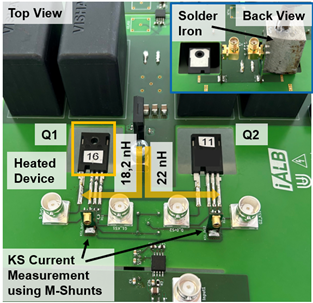
Bond wire lift-off behaves quite differently. Removing bond wires increases both the source resistance and inductance of a device, which simply shifts the KS current waveform in one direction, in both the transient and steady-state phases, without the reversal seen for temperature. While the steady-state values for both effects can end up looking similar, the transient shape does not — the opposite-direction peak is a reliable fingerprint of a temperature disturbance rather than genuine degradation.
The findings point to the transient KS current, not just its steady-state value, as the more robust basis for real-time health monitoring — and the authors suggest that an AI-based evaluation of the signal is a promising next step towards distinguishing the two effects reliably in the field.
Related publication The underlying research will be presented at ICSCRM 2026, Yokohama, Japan (27 September – 2 October 2026).