Can a healthy chip be told apart from a degraded one just by feeding its switching waveform into a neural network? A new collaboration between Kyushu University and IALB shows that it can — and that the Kelvin-source current is the one input the network can trust even when temperature gets in the way.
Bond wire lift-off is one of the classic wear-out mechanisms in power modules: as wires fatigue and detach, the source resistance and inductance of the affected chip rise, current sharing between parallel devices shifts, and the switching waveform changes shape. Machine-learning classifiers trained on such waveforms have already shown promise for detecting lift-off without any dedicated monitoring circuit — but almost always for a single chip. Real power modules, however, are built from several chips in parallel, and it was unclear whether the same approach would still work once device-to-device mismatch and temperature differences start shaping the waveform as well.
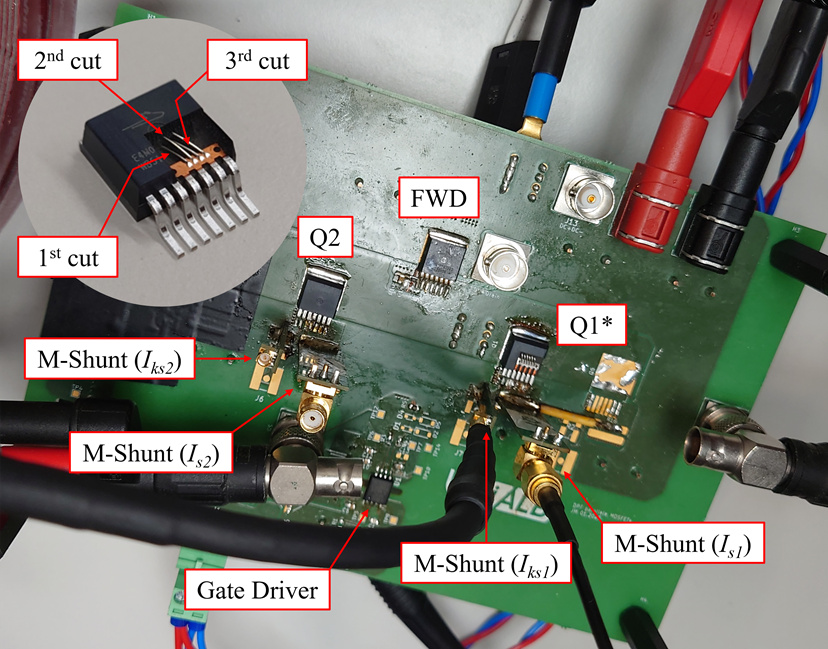
The study addresses exactly that. Two discrete SiC-MOSFETs were connected in parallel and put through double-pulse tests, with the M-Shunt measuring the load current and a Mini-M-Shunt measuring the Kelvin-source current. Source bond wires were then cut in a controlled sequence — from all four intact down to just one remaining — to simulate four stages of degradation, from healthy to heavily damaged. A convolutional neural network was trained to classify the degradation stage from the switching waveform, and the experiment was repeated across three current-balance conditions, obtained by pairing devices with different threshold voltages.
The gate voltage and the Kelvin-source current turned out to be the most dependable inputs, both reaching close to 100 % classification accuracy regardless of current imbalance or which of the two devices was evaluated. The drain-source voltage and load current, by contrast, were far less consistent — drain-source voltage accuracy collapsed to around 25–30 % during turn-off, and load-current accuracy dropped to about 52 % for one device during turn-on, simply because degradation left too faint a mark on those particular waveform segments.
The more demanding test came next: could rising temperature alone — with no wires cut at all — fool the network into reporting degradation? For the gate voltage during turn-on, the answer was yes: its ringing amplitude fades with temperature in much the same way it fades with wire lift-off, and the classifier’s healthy-state accuracy dropped to almost 0 % once the device was heated. The Kelvin-source current showed no such confusion. Across every temperature step tested, it kept a healthy-state classification rate of around 99–100 %, correctly recognising an undamaged device as undamaged even as its temperature rise by close to 60 °C.
That combination — high sensitivity to genuine degradation and near-total immunity to temperature-driven false alarms — is what makes the Kelvin-source current a particularly promising basis for machine-learning-based condition monitoring in parallel-chip power modules, without adding dedicated sensing hardware beyond the M-Shunt itself.
Related publications